Thursday, 18 February 2016

WHAT HAS HAPPENED IN SPAIN SINCE 1975?

Today, Spain is a democracy. Every four years there are elections to choose the government.
After Juan Carlos became king in 1975, the transition to democracy began. It ended in 1978 with a new constitution. Important reforms were introduced by the Prime Minister, Adolfo Suarez.
By Verhoeff, Bert / Anefo (Nationaal Archief) [CC BY-SA 3.0 nl (http://creativecommons.org/licenses/by-sa/3.0/nl/deed.en)], via Wikimedia Commons

  • All political parties were made legal.
  • There was a democratic election in 1977.
  • A new constitution was written.
By Infinauta (Own work) [Public domain], via Wikimedia Commons
 In 1978 people voted in favor of the constitution in a referendum. It established that:
Citizens have rights and responsibilities. Everyone must obey the law.
Citizens vote for their representatives freely in elections.
Spain recognizes regional autonomy.
Spain is a parliamentary monarchy. The monarch is head of state but doesn´t govern or make laws.
Government is separated into three branches: the legislative, executive and judicial branches.

Since the transition two parties have governed Spain most of the time: the Socialist party (PSOE) and the Popular party (PP).
In 1981 there was an attempt military coup against the government led by Tejero. It failed.
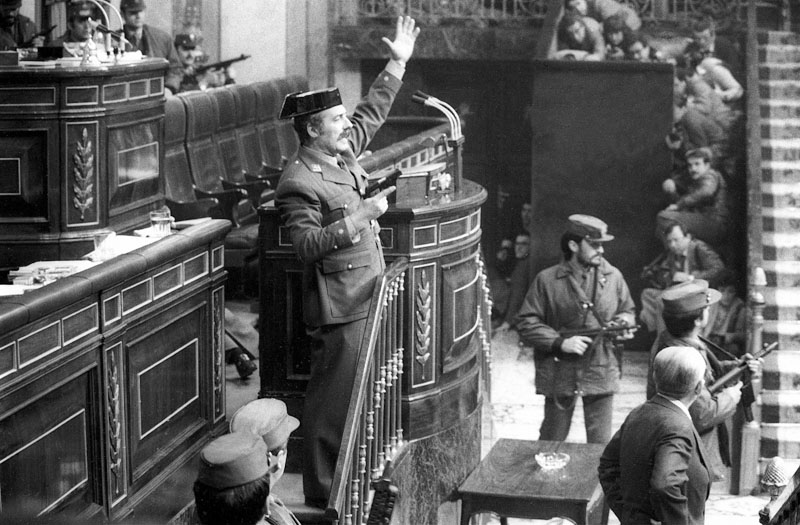
Tejero. Photo by Manuel Pérez Barriopedro
In 1986 Spain became a member of the EEC (now UE).
By MPD01605 [CC BY-SA 2.0 (http://creativecommons.org/licenses/by-sa/2.0)], via Wikimedia Commons
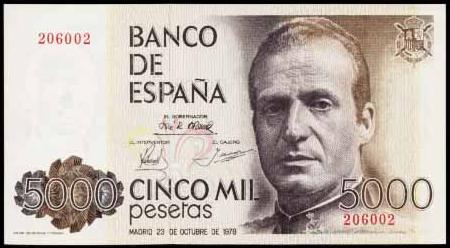
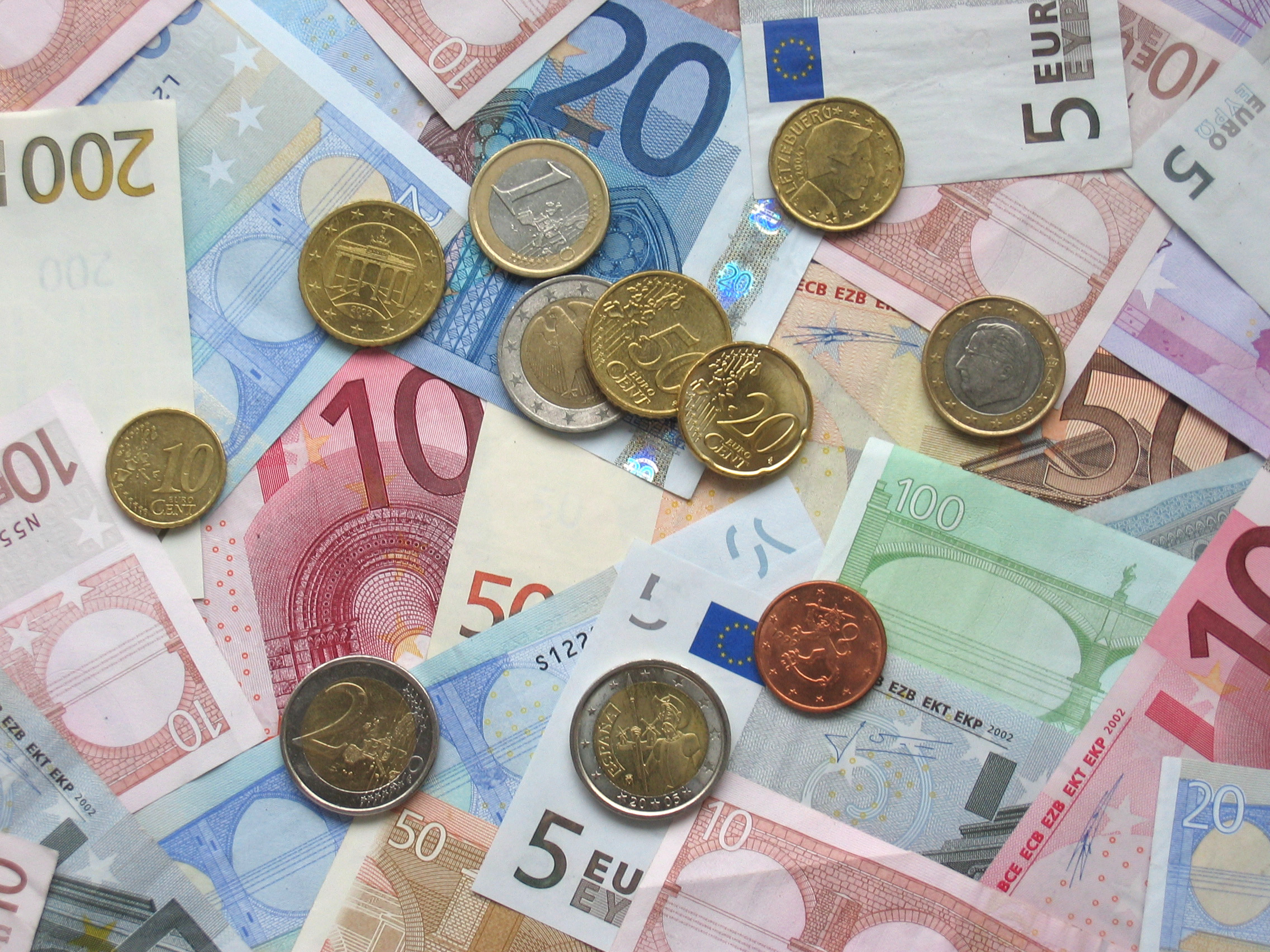
In 1992 the euro replaced the peseta as Spain´s currency.
By Iu96 (Own work) [GFDL (http://www.gnu.org/copyleft/fdl.html) or CC BY 3.0 (http://creativecommons.org/licenses/by/3.0)], via Wikimedia Commons
By Avij (talk · contribs) (Own work) [ECB decisions ECB/2003/4 and ECB/2003/5 or Public domain], via Wikimedia Commons</a>


WHAT WAS SPAIN LIKE DURING FRANCO'S DICTATORSHIP?

After the Nationalists won the Spanish Civil War, Franco established his dictatorship. He took complete control of the country.
This dictatorship was based on three pillars: the military, the Catholic Church and the Falange.
  • The constitution was abolished and there were no more democratic elections.
  • Political parties became illegal.
  • Trade unions becme illegal.
  • Freedom of press was controlled by censorship.
  • There was no regional autonomy.
Many people who opposed Franco went to live in the United Kingdom, France and other countries. Republicans who stayed in Spain were often imprisoned or killed.
In the 1940s and 1950s: there wasn't much food and most people were very poor. Spain didn't participate in the Second World War but Franco supported Germany. Spain wasn't allowed to be a member of the United Nations because it was a dictatorship.

In the 1960s: the economy started to improve. Tourism started to become important. Franco named Juan carlos de Borbón as his sucessor.
In the 1970s: Franco was ill and old. His supporters were divided: some wanted to continue as before and others wanted reform. Admiral Carrero Blanco was prime minister. He wanted to continue the dictatorship without any reforms. He was killed by the Basque terrorist group ETA in 1973. In 1975 Franco died and Juan Carlos became King of Spain.

Sunday, 14 February 2016

WHAT WAS THE SPANISH CIVIL WAR?

In July 1936 a military rebellion began in Spanish Morocco. Its leader was General Francisco Franco.
Francisco Franco. Via Wikimedia Commons
The rebels took control of parts of Spain. The country became divided between areas controlled by the Nationalists (the rebels led by Franco) and areas controlled by the Second Republic.
Spanish Civil War August-September 1936. Booshank at en.wikipedia [CC BY-SA 3.0 (http://creativecommons.org/licenses/by-sa/3.0) or GFDL (http://www.gnu.org/copyleft/fdl.html)], from Wikimedia Commons
Franco and the Nationalists were opposed to the changes of the Second Republic. They wanted to replace the republic with a right-wing dictatorship (Germany and Italy supported them). The Republicans supported the Second Republic (Russia, the Soviet Union, supported them).
For three years there was fighting, until the Nationalists took control of Madrid. The war ended in April 1939. The Nationalists won, the Second Republic ended and Franco established a right-wing dictatorship.

Consequences from the war:
  • 365.000 people died.
  • Many people lost their family.
  • People were imprisoned or killed because of their opinions (Nationalists who lived in the Republican zones and Republicans who lived in the Nationalists zones).
  • Roads, bridges, railways and buildings were destroyed.
  • People became ill because there wasn't enough food.

WHAT HAPPENED IN SPAIN IN THE EARLY 20TH CENTURY?

The start of the 20th century was the continuation of the Restoration, which began when Alfonso XII became king in 1874. Alfonso XII died in 1885.
Alfonso XII and his second wife María Cristina. By F. Barcia Viet. Sevilla (Los Borbones) [Public domain], via Wikimedia Commons
 Spain was ruled by his wife María Cristina until Alfonso XIII turned 16 in 1902.
Alfonso XIII. By Christian Franzen [Public domain], via Wikimedia Commons.
 During Alfonso XIII's reign Spain experienced political and social conflict.
  • The Liberals and Conservatives continued to take turns in government. Republican parties, the Socialist party and nationalist parties in Cataluña and Pais Vasco opposed them.
  • There were many strikes, workers demanded better working conditions.
  • Spain was involved in military conflict in its new colonies in Morocco.
In 1923 there was a military coup. General Primo de Rivera established a dictatorship with Alfonso XIII's support:
  • The constitution was suspended, the king lost most of his powers.
  • Political parties became illegal.
  • Freedom of press was limited by censorship.
Alfonso XII y Miguel Primo de Rivera. Bundesarchiv, Bild 102-09411 / Unknown / CC-BY-SA 3.0 [CC BY-SA 3.0 de (http://creativecommons.org/licenses/by-sa/3.0/de/deed.en)], via Wikimedia Commons
At first Primo de Rivera was supported by many people. Later on he had the opposition from the army and from Alfonso XIII. Primo de Rivera resigned in 1930.
 In 1931 the Republicans and the Socialists won the municipal elections and the Second Republic began. Manuel Azaña became president.

Manuel Azaña. See page for author [Public domain], via Wikimedia Commons
There was a new constitution and Spain became a democracy: all men and women could vote. There were many other changes:
  • The church lost control of education. Public schools were established.
  • There was more regional autonomy. There was a statute of autonomy for Cataluña. 
  • The Industrial Revolution changed how society was organised.
These reforms divided Spanish society and caused political conflict.: Left-wing people supported the changes,  Right-wing people opposed the changes.

Thursday, 4 February 2016

MEDICAL ADVANCES HELP REPRODUCTION

Medical advances can help at specific stages of reproduction.
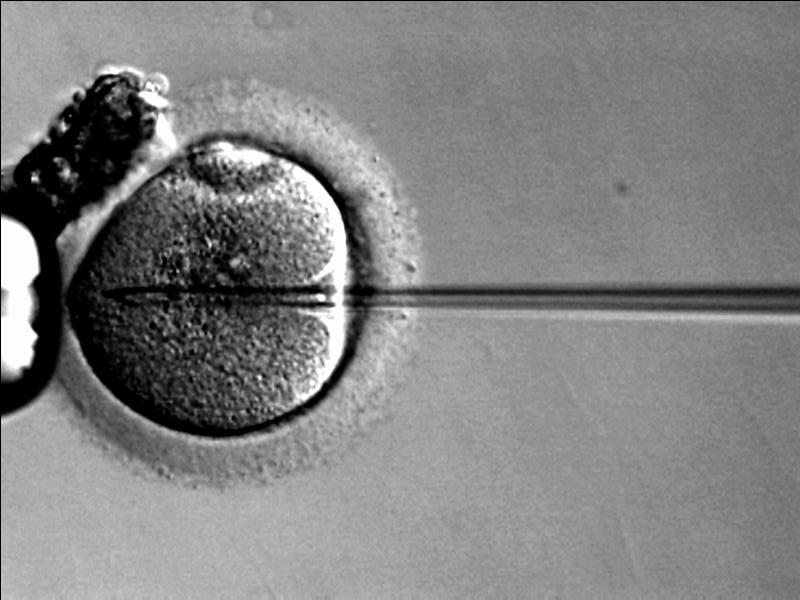
Fertilisation: In-vitro fertilisation is a procedure that involves joining the male and female reproductive cells outside the woman's body, in a laboratory. If fertilisation occurs, the zygote is placed inside the woman's uterus.


Birth: one of the problems which can occur during birth is the breech birth, doctors usually perform a Cesarean section. They extract the fetus through a small cut they open through the lower abdomen and the wall of the uterus, instead of through the mother's vagina.

https://www.youtube.com/watch?v=xyN48VnRYUY
Click on this photo to watch a video about Cesarean Section.
Pregnancy: during pregnancy specialist doctors check the mother and the fetus health. They analyse blood and urine samples to detect infections in the fetus. To detect problems (abnormalities) in the fetus, doctors analyse amniotic fluid extracted from the amniotic sac. This procedure is known as amniocentesis. They also use an ultrasound scan to check the developing organs and bones in the fetus and its growth as well.


Tuesday, 2 February 2016

FERTILISATION


FERTILISATION
A man and a woman have sexual intercourse. The man deposits his semen in the woman's vagina. The sperm cells swim into the uterus and up the fallopian tubes, where one of them will fertilise the female egg cell. When a sperm cell joins with an egg cell in the fallopian tube, they form a new cell called a zygote (click here to watch a video about fertilisation). The zygote that results goes into the uterus. as it travels, it divides many times to form a group of cells called an embryo, and finally it develops into a fetus.

Zygote at the eight cell stage. Via bbc.co.uk
8 cell embryo at day 3. By ekem, Courtesy: RWJMS IVF Program [Public domain], via Wikimedia Commons.
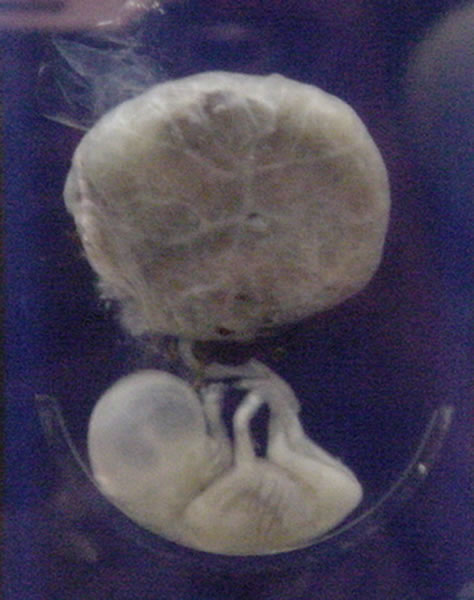
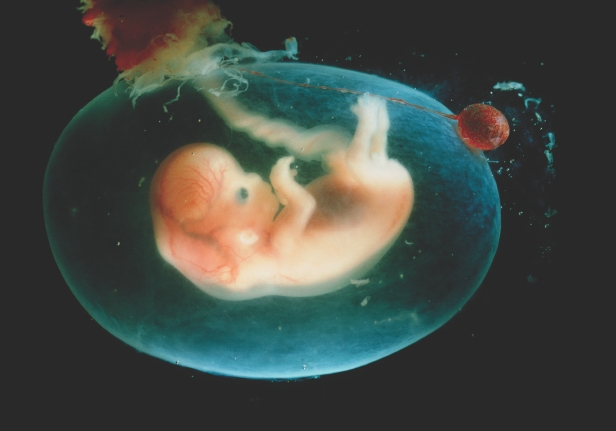
Fetus 3 months. By National Museum of Health and Medicine [Public domain], via Wikimedia Commons.
PREGNANCY
Pregnancy is the period of time between the fertilisation of an egg cell and the birth of a baby.
The placenta provides the fetus with oxygen and nutrients from the mother's blood. It also takes away carbon dioxide and waste that the fetus produces.
The fetus is connected to the placenta by the umbilical cord.

The amniotic sac contains a liquid called amniotic fluid. This liquid supports the fetus and protects it.

Placenta and umbilical cord. By Gray38.png: User Magnus Manske on en.wikipedia derivative work: Amada44  talk to me (Gray38.png) [Public domain, Public domain, Public domain or Public domain], via Wikimedia Commons
Fetus in the amniotic sac, via howitworksdaily.com


WHAT HAPPENS DURING BIRTH?

During birth (click on the word birth to watch a video) the walls of the uterus start to contract. Then the cervix gets wider to enable baby to come out of the uterus. Next the amniotic sac breaks and the contractions push the baby into the vaginal canal.

Once the baby is outside the mother's body he starts to breathe and the doctor cuts the umbilical cord. Finally the amniotic sac, the placenta and the rest of the umbilical cord are expelled. 


THE MALE REPRODUCTIVE SYSTEM


The foreskin is a fold of skin that covers the end of the penis
The testicles produce sperm cells. They are suspended inside a bag of skin called the scrotum.
The vas deferens is a tube which sperm cells travel through from the testicles to the seminal vesicles, the prostate and the urethra.
The seminal vesicles produce a liquid that becomes part of the semen.
The prostate produces a white liquid. This liquid makes up the semen.
The urethra is a tube that goes from the bladder through the prostate, and out the end of the penis. The urethra carries both semen and urine out of the body.
The penis is an elastic organ. The end of the penis is called the glans.


Male Reproductive System. Via mayoclinic.org.
Male Reproductive System. Via humananatomybody.info
HOW DOES THE MALE REPRODUCTIVE SYSTEM WORK?
1.- First, sperm cells are produced inside the testicles.
2.- Then the vas deferens transport sperm cells from the testicles to the seminal vesicles.
3.- Next, the sperm cells are transported through the prostate into the urethra.
4.- Finally the semen travels through the urethra and out of the penis. This process is called ejaculation.